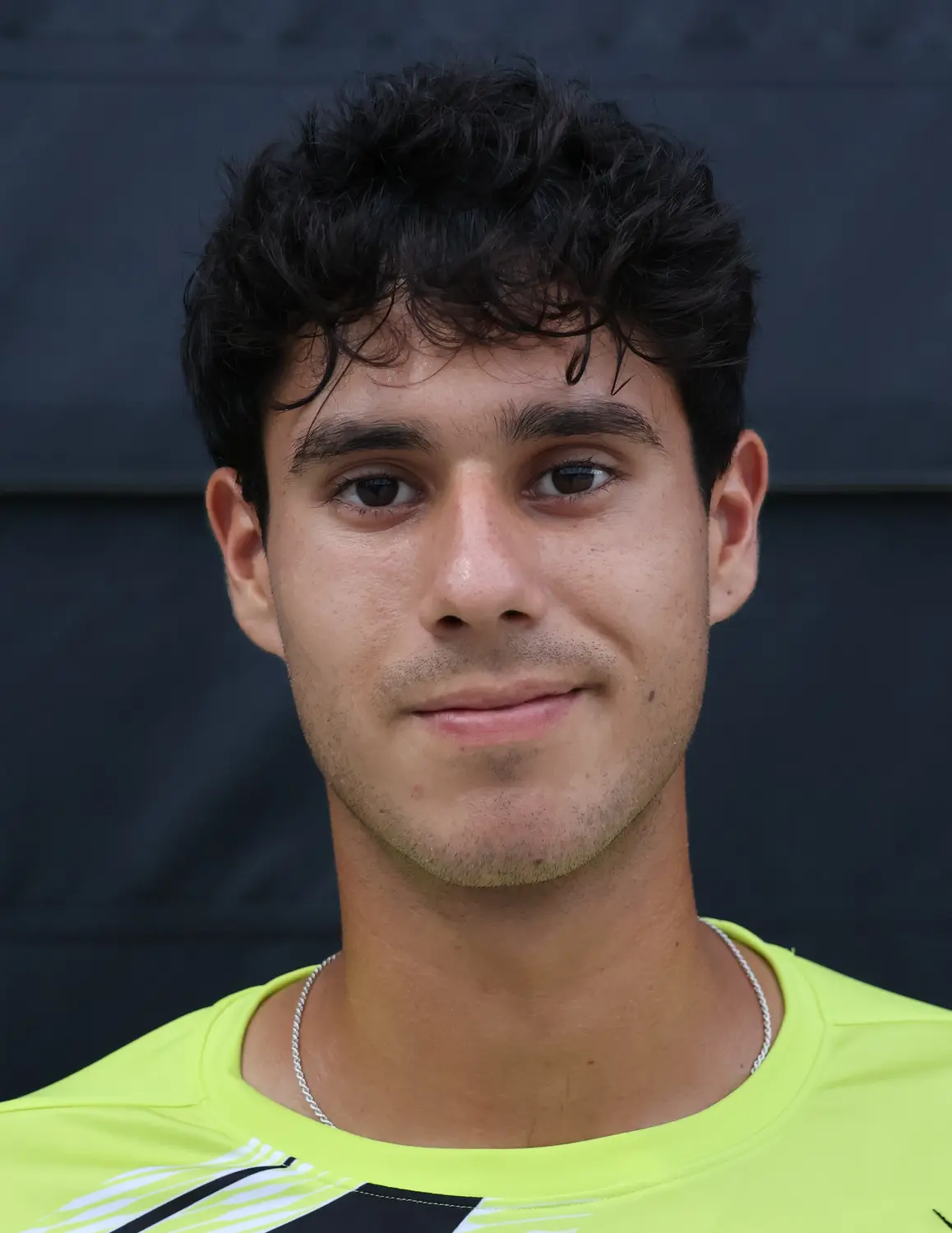
 Daniel Vallejo
- Hangzhou seed
- No. 5
- Age
- 22
- Challenger record at 16 March
- 16–2
The rise was built before the main-tour spotlight arrived
The useful starting point is February, not Hangzhou. Vallejo finished 2025 by winning the Guayaquil Challenger, then opened this season with consecutive Challenger titles in Itajaí and Concepción. In the Concepción final he beat Alejandro Tabilo 6-2, 1-6, 6-1. By 16 March, ATP Tour reported a 16-2 Challenger record for the year and a debut at No. 99 in the rankings. That sequence matters because it shows repeated work rather than one isolated upset. It also creates the central caution around his current profile: much of the foundation was laid on clay, in conditions and match patterns that cannot simply be copied onto the hard courts of the Asian swing.
Madrid showed that the ceiling was already moving
Vallejo's 6-4, 6-4 victory over Grigor Dimitrov in Madrid was important for more than the name on the other side of the net. It came on his Masters 1000 debut and made him only the second Paraguayan to record a win at that level since the series began in 1990. ATP's report placed him at No. 84 in the live rankings after the match. We read that result as evidence that his Challenger success could withstand a sharper increase in opponent quality. But Madrid was still clay. It answered a question about competitive scale more convincingly than it answered a question about surface range.
Båstad changed the expectation, but reinforced the same surface story
The summer run in Båstad added another layer. Vallejo beat Botic van de Zandschulp in a three-set match lasting two hours and 57 minutes, then defeated Stefano Travaglia 7-6(5), 6-2 to reach the semi-finals. ATP recorded him as the first Paraguayan man to reach a tour-level quarter-final in 20 years and then the fourth Paraguayan man to make an ATP Tour semi-final. His live ranking reached No. 61. Those are meaningful national and personal milestones. They also arrived on clay. The more he proved there, the more valuable a strong hard-court week became—not because clay results count less, but because transferable strength is a different achievement from surface-specific excellence.
A seed has to manage a different kind of pressure
Being seeded fifth changes the public shape of Vallejo's week. Earlier breakthroughs allowed him to attack a more established opponent with little expectation attached to his name. In Hangzhou, the draw formally places him above much of the field. That does not guarantee a favourable matchup or a deep run, and it says nothing by itself about how his game will interact with a particular opponent. It does mean that a first-round win will be treated as normal rather than exceptional. For an emerging player, learning to produce an ordinary result when everyone expects it can be as revealing as producing a spectacular upset when nobody does.
What hard courts ask the evidence to prove
We are not using a clay-to-hard change to invent tactical weaknesses. The available results do not tell us, on their own, that Vallejo's serve will become less effective or that his movement will fail. The practical test is simpler and observable. Can he protect enough service games without the extra time clay often provides? Can he create return pressure against opponents whose first strike is rewarded more quickly? Can he keep the score stable when a short run of points decides a set? A good Hangzhou performance would not need to look identical to Båstad. In fact, the most persuasive evidence of growth would be an ability to win through the demands of the new setting rather than reproduce the old one.
The strongest argument against making Hangzhou decisive
One tournament is a poor judge of a player's complete surface identity. A difficult opponent, a few tie-break points or an unusually strong serving day can end a week before a broader pattern has time to appear. Vallejo is also 22, which makes development more important than a permanent label. A loss in Hangzhou would not erase three Challenger titles, a Masters 1000 debut win or an ATP semi-final. That is the serious counterargument to our emphasis: the event is timely evidence, not a final examination. We accept it. Our position is that Hangzhou matters because it starts the next question, not because one score can finish it.
What would change our view
A single deep run would raise confidence, but repeated hard-court wins against different types of opponent would change the assessment more. We would want to see Vallejo hold his level after the first surprise has gone, handle both stronger servers and longer baseline exchanges, and reproduce that evidence beyond one venue. Conversely, several hard-court events in which he struggles to protect serve or generate return opportunities would support a more surface-specific reading of his rise. For now, our opinion is deliberately positive but conditional: the fifth seed has been earned by a substantial season; the next claim, that Vallejo's level travels, still has to be built point by point.
Your take
Would a strong hard-court week change how you rate Vallejo's 2026 rise, or has he already proved enough?
Discuss this story on X →Sources & context
- ATP Tour — official Hangzhou draw and seeds, accessed 23 September 2026
- ATP Tour — how Vallejo broke into the Top 100, 16 March 2026
- ATP Tour — Vallejo beats Dimitrov on his Masters 1000 debut, 23 April 2026
- ATP Tour — Vallejo reaches the Båstad semi-finals, 17 July 2026
- Wikimedia Commons — Daniel Vallejo at the 2023 Cary Challenger
Figures are tied to the stated snapshot. Commentary does not replace a match-specific assessment. See our editorial policy and corrections policy.
Explore player profiles · View recorded results · Explore tournaments
Keep reading
Sinner vs Alcaraz: what hard-court Elo says about the rivalry →
Michael Zheng: why his Elo deserves a closer look →
Canada beat France at home. The crowd helped—but it did not win the tie. →