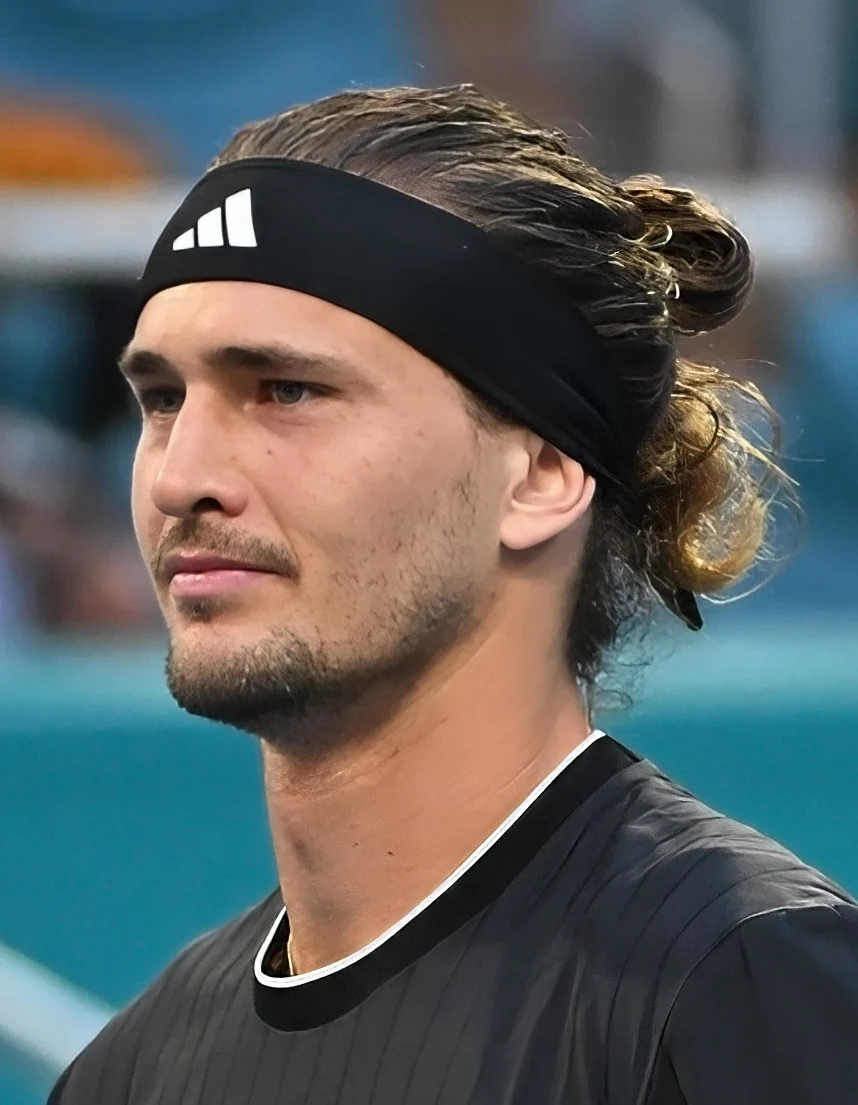
 Alexander Zverev
- 2026 service points won
- 71.2%
- 2025 service points won
- 68.1%
- 2026 tour record
- 53–13
A stronger service foundation
Percent · zero-based scale
The strongest evidence is in the service games
The season snapshot puts service points won at 71.2%, compared with 68.1% in 2025; hold rate moves from 86.5% to 89.5%. Return points won, meanwhile, are lower: 36.5% against 37.4%. We read that as a meaningful service-led case for stronger results, rather than proof of an across-the-board transformation. The same player can become harder to break without becoming more effective at breaking everyone else.
A scoreline can conceal the difficult part
The recent-results table records five-set matches against Sonego and Halys early in the US Open, then a straight-sets semi-final with two tie-breaks against Khachanov. Those are different competitive demands hidden inside the same seven-match winning run. Our interpretation is that resilience and control should not be treated as synonyms. Zverev showed he could get through difficult passages; that does not mean the passages were never difficult.
Which opponents have actually been answered?
The US Open route included opponents ranked 89, 52, 28, 22, 70, 50 and 9 when the event began. Ranking is an imperfect strength measure, but this is plainly a different test from repeatedly beating the very top. In 2026 finals against Sinner, Zverev lost in Madrid and at Wimbledon; he beat Cobolli at Roland Garros and Shelton in New York. Those results argue for respecting an excellent season without assuming the hardest matchup has been solved. Tennis Abstract’s September 14 profile places him third in hard-court and clay Elo and second on grass. That opponent-sensitive rating picture supports elite status, while leaving room above him.
Titles answer one question, not every question
A trophy proves that a player solved the sequence of matches placed in front of him. It does not prove that every possible matchup in the field would have produced the same outcome. This distinction is sometimes treated as an attempt to diminish the champion; we see it as the basis of serious previewing. Zverev’s achievement and improved serving deserve full weight. The next opponent still deserves individual attention. A returner who consistently engages the second serve, or a player who changes direction without giving away court position, may test a part of the profile that the previous draw did not expose as often.
What sustainable dominance would look like
The strongest case for a lasting step forward would combine the present service gains with stable return pressure against elite opposition. That would reduce dependence on tie-breaks and narrow passages, making the advantage visible across more scorelines. Conversely, if future wins continue to require exceptional first-serve numbers while return performance remains flat, the assessment should stay more opponent-sensitive. Neither outcome erases the trophies. The point is to understand what travels from one tournament to the next. CourtValue’s position is that results establish credibility, while the mechanism behind those results determines how confidently they can be projected into a new match.
The crown is earned; the forecast is still open
The best objection to this caution is that surviving pressure is itself a skill. We agree. Repeatedly managing demanding moments deserves weight. What we resist is using the trophy as a substitute for examining how the next opponent attacks his second serve or protects their own service games. A stronger server can still encounter a difficult returner. For CourtValue, the useful opinion is neither to follow the champion automatically nor to oppose him for attention. It is to recognise the improvement and still ask what the particular contest demands.
Your take
Does a title change your view of a player more than the way they won their matches?
Discuss this story on X →Sources & context
Figures are tied to the stated snapshot. Commentary does not replace a match-specific assessment. See our editorial policy and corrections policy.
Explore player profiles · View recorded results · Explore tournaments
Keep reading
Alexander Bublik: unpredictable, or misunderstood by surface? →
Canada beat France at home. The crowd helped—but it did not win the tie. →
Rafael Jódar’s breakthrough: how much should expectations rise? →