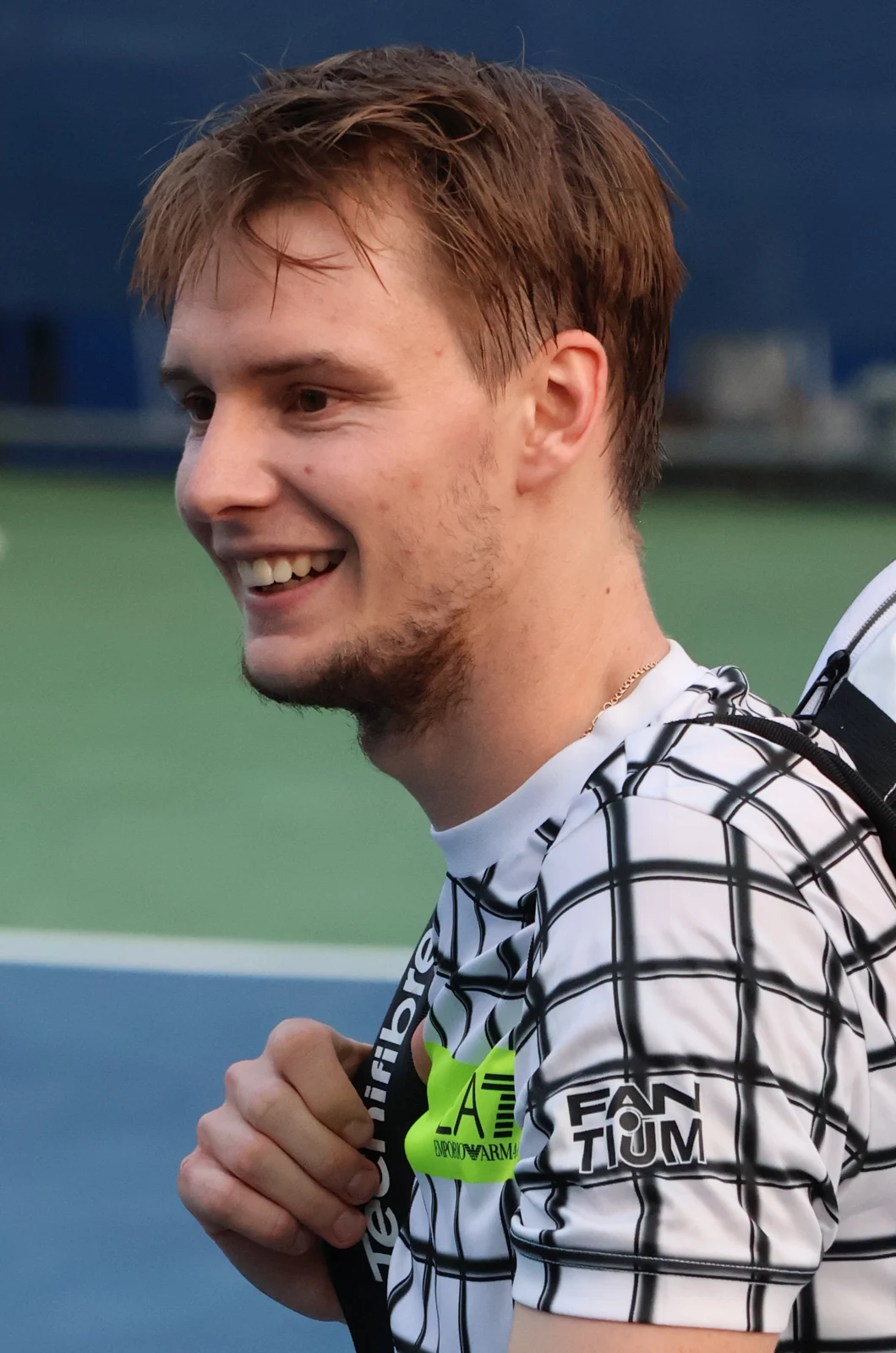
 Alexander Bublik
- 2026 hold rate
- 86.9%
- 2026 break rate
- 16.1%
- 2026 double-fault rate
- 4.4%
Second-serve outcomes have improved
Percent · zero-based scale
Some of the risk has actually fallen
Tennis Abstract’s snapshot records an 86.9% hold rate and a 16.1% break rate in 2026. Double faults fall from 6.6% in 2025 to 4.4%, while second-serve points won rise from 47.9% to 51.4%. We read that as evidence against treating every match as indiscriminate risk-taking. There is an improvement in the serving numbers even though it has not turned into a dominant return profile.
One surface label will not solve him
We would not replace the personality shortcut with another shortcut that says to trust him only on grass. The September 14 player-profile Elo table places him ninth on grass and twenty-third on both hard and clay. Those relative positions are more informative than assuming the largest raw rating identifies his best competitive setting across different pools. The opponent still matters: a player who protects serve well may give Bublik few chances to exploit his own service strength.
Clay results also challenge the stereotype
His 2025 titles included Halle on grass, Gstaad and Kitzbühel on clay, and Hangzhou on hard courts. In 2026 he won Hong Kong on hard and reached another Kitzbühel final. We see that as a strong objection to a blanket “fast courts only” rule. At this year’s US Open, Mannarino entered ranked 67 and Paul 21; Bublik’s dominance ratio moved from 2.58 in the win to 0.78 in the loss. That ratio compares return points won with service points lost; it is descriptive, not an opponent-adjusted forecast. Different opposition can explain a great deal of apparent inconsistency without any invented account of his motivation.
Thin return margins can look like inconsistency
A serve-led player may move quickly between comfortable holds and sets decided by one loose game. When return opportunities are scarce, the scoreboard can swing without a dramatic change in overall point quality. That pattern is easily described as unpredictability because the result feels sensitive to a few moments. Our interpretation is more mechanical: Bublik’s margin often depends on protecting serve and converting a limited number of return openings. The profile can produce sudden score changes while remaining statistically recognisable. Understanding that structure is more useful than deciding after the fact which version of the player appeared.
Surface is part of the explanation, not the whole explanation
Faster conditions can make first-strike tennis more valuable, but they can also leave fewer chances to recover from a weak return game. Slower conditions may create more rallies while asking the server to win the same point twice. The opponent determines which trade-off matters. A disciplined returner who keeps making Bublik play can expose the narrow margin even on a favourable surface; an opponent who offers short service games may allow him to take control elsewhere. We would change our view if the return numbers improved across different opponent types. Until then, the safest description is not random: dangerous on serve, more conditional on return.
Our practical read: watch the available openings
Bublik’s US Open results show why a previous scoreline should not settle the next assessment: a comfortable win over Mannarino was followed by a five-set defeat to Tommy Paul. We would not invent a psychological explanation for that contrast. Our question would be whether the next opponent can keep him working in his own games while denying easy return opportunities. The counterargument is that a serving burst can erase a lot of that pressure very quickly. Exactly: the profile can be dangerous without being inexplicable. That is the opinion we would carry into a matchup.
Your take
Do we call Bublik unpredictable too quickly when the opponent changes?
Discuss this story on X →Sources & context
- Tennis Abstract — Alexander Bublik season statistics and recent results
- Tennis Abstract — surface Elo snapshot, 14 September 2026
Figures are tied to the stated snapshot. Commentary does not replace a match-specific assessment. See our editorial policy and corrections policy.
Explore player profiles · View recorded results · Explore tournaments
Keep reading
Ben Shelton’s return game: has it caught up with his serve? →
Alexander Zverev: what his titles tell us about his next match →
Canada beat France at home. The crowd helped—but it did not win the tie. →