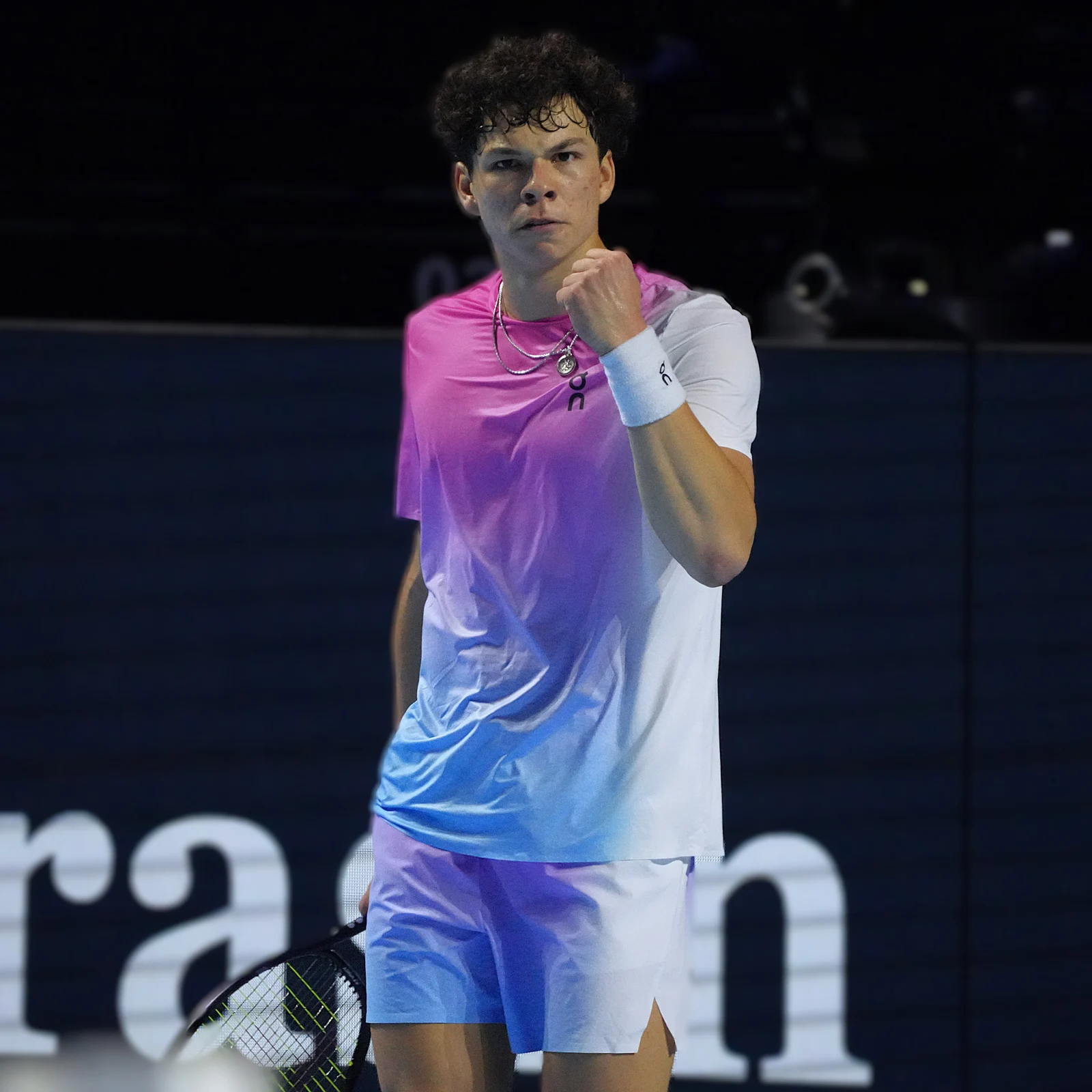
 Ben Shelton
- 2026 service games held
- 90.4%
- 2026 return points won
- 33.3%
- 2025 return points won
- 33.3%
The improvement is uneven
Percent · zero-based scale
More security in his own games
The Tennis Abstract snapshot shows his hold rate rising from 87.3% in 2025 to 90.4% in 2026, with service points won moving from 67.9% to 70.8%. Return points won sit at 33.3% in both years, while break rate falls from 16.6% to 15.3%. These are season aggregates with different opposition, not a controlled experiment. Even so, the contrast supports a clearer opinion than simply saying that everything has improved.
What that changes when the score gets tight
Our reading is that Shelton can now ask an opponent to sustain a higher level simply to find an opening on his serve. But a secure hold does not create a break at the other end. Against another effective server, the decisive question becomes whether he can manufacture pressure before the set reaches a handful of high-leverage points. We would look for repeated uncomfortable service games from the opponent, not just one spectacular return winner.
The final exposed the distinction
The championship match made the season-level concern tangible. Zverev won 68 of 80 points behind his first serve. Shelton therefore won just 12 of those 80 return points: 15%, calculated from the official match report. That is one opponent on one afternoon, not Shelton’s general return level. But our interpretation is that the final demanded exactly the part of his game that the wider numbers leave unresolved. The run establishes that he belongs in the conversation; it does not establish that every elite service game is now within reach.
A serve-led profile changes the shape of every set
When a player holds this frequently, opponents receive fewer low-cost opportunities. A poor return game becomes more damaging because the next chance may not arrive before a tie-break. For Shelton, that dynamic cuts both ways. His service improvement can keep him close against almost anyone, but limited return pressure can make the score depend on a very small number of points. That is not simply variance or personality; it is a structural consequence of how the games are being won. The practical question is whether he can create enough ordinary return pressure that the spectacular point is no longer required to change the set.
Why the next improvement may be less visible
Return progress does not need to appear first as a dramatic rise in breaks. Better depth on neutral returns, more second serves put back in play and more games reaching 30-all can gradually alter an opponent’s behaviour. Those developments are harder to celebrate than serve speed, but they can make a strong server more complete. We would look for repeated evidence across opponents with different delivery patterns. If Shelton starts extending a larger share of return games without sacrificing his own service efficiency, the argument changes. Until then, the serve remains the clearest foundation and the return the area that decides how often that foundation becomes a full match advantage.
The next step need not be dramatic
The counterargument is that season averages can miss a recent change or an especially good return matchup. That is fair, and we would not use these numbers to dismiss a specific performance. Our position is narrower: the evidence for an improved serve is currently clearer than the evidence for an improved return. For the next preview, that distinction matters more than the finalist label. We would ask whether the opponent lets Shelton apply enough return pressure to complement the service advantage, rather than assuming the latest run has answered the question forever.
Your take
Which would raise Shelton’s ceiling more: another step on serve, or more pressure in return games?
Discuss this story on X →Sources & context
- Tennis Abstract — Ben Shelton season statistics and recent results, retrieved 17 September 2026
- US Open — 2026 men’s final report, 13 September 2026
Figures are tied to the stated snapshot. Commentary does not replace a match-specific assessment. See our editorial policy and corrections policy.
Explore player profiles · View recorded results · Explore tournaments
Keep reading
Alexander Bublik: unpredictable, or misunderstood by surface? →
Canada beat France at home. The crowd helped—but it did not win the tie. →
João Fonseca: is his game stronger on hard courts or clay? →